.png)

Sermon: Who Are We to Take a Life? 12/09/2026

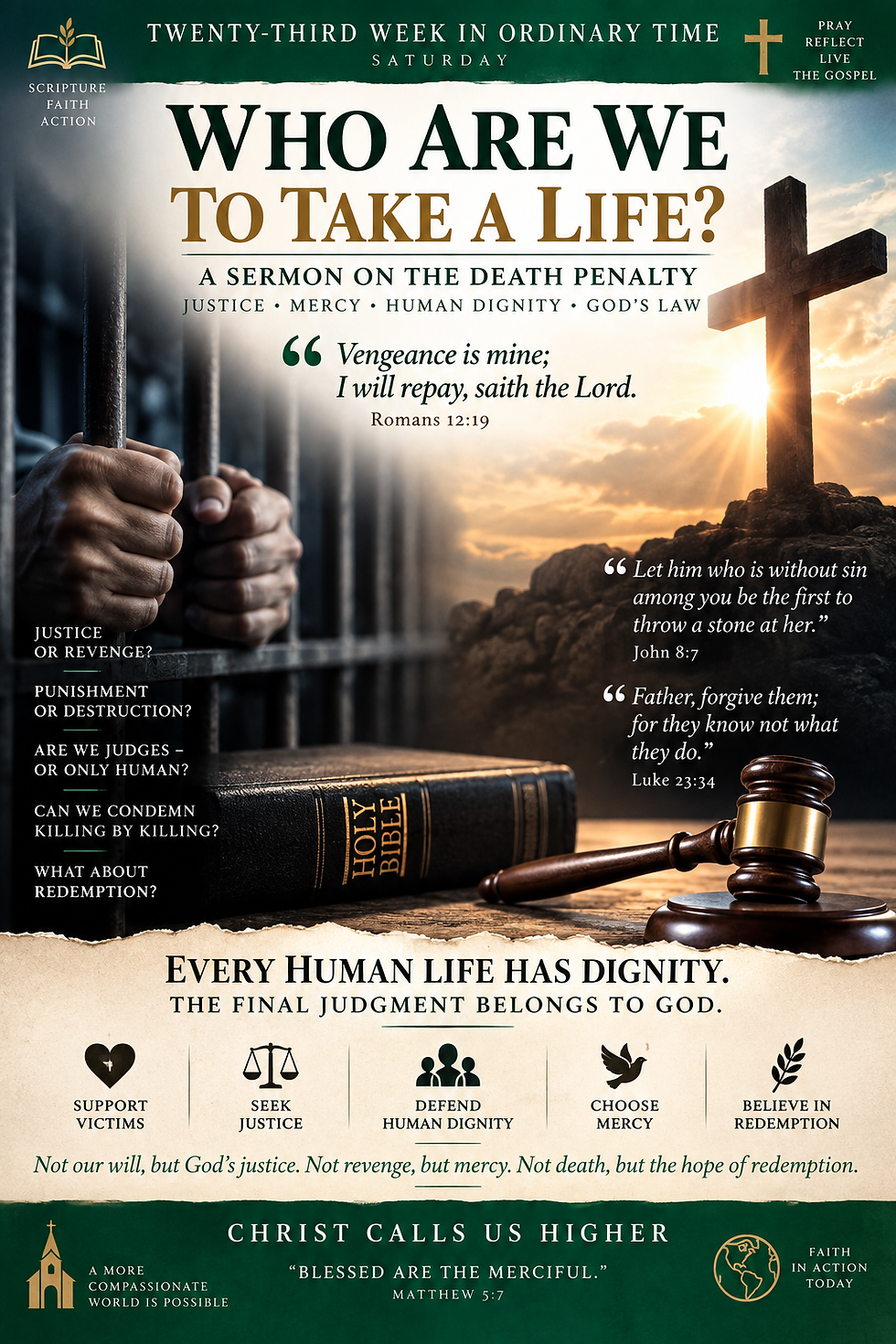
Who Are We to Take a Life?

A Christian Reflection on the Death Penalty, Justice, Mercy and the Authority of God
“Vengeance is mine; I will repay, saith the Lord.” — Romans 12:19
My brothers and sisters in Christ,
Today I want to speak about a subject that is difficult, controversial and deeply serious.
The death penalty.
There are crimes so horrific that they fill us with anger.
There are acts of violence so terrible that our immediate human reaction may be:
“They deserve to die.”
When an innocent person is murdered, when a child is killed, when somebody commits an act of unimaginable cruelty, anger is understandable.
Justice matters.
Victims matter.
Their families matter.
Their suffering must never be forgotten in our eagerness to speak about forgiveness.
But as Christians, we must ask a question that goes beyond our anger:
Who are we to deliberately take the life of another human being once that person is already under our control?
And if our answer is, “because the law permits it,” another question immediately follows:
Does the law of man automatically make something the will of God?
“You Shall Not Kill”
Among the commandments given to Moses we hear:
“Thou shalt not kill.”
More precisely translated, the commandment prohibits murder.
And Scripture itself contains passages where capital punishment existed within the legal system of ancient Israel.
So we must be truthful with Scripture.
We cannot simply claim that the Bible never contains the death penalty.
It does.
The Old Testament describes a society radically different from ours, and its legal codes included death for a number of offences.
But Christians do not read one verse of Scripture in isolation.
We read Scripture through Jesus Christ.
And when we encounter Christ, something extraordinary happens.
Again and again, Jesus takes humanity beyond retaliation and towards mercy.
“AN EYE FOR AN EYE”
Jesus Himself addresses the ancient law of retaliation:
“You have heard that it was said, ‘An eye for an eye and a tooth for a tooth.’”
But He continues:
“But I say unto you…”
And Christ points His followers away from vengeance.
That matters.
Because the Gospel continually asks us to resist the instinct that says:
“You hurt me, therefore I must hurt you.”
“You took something from me, therefore I must take something from you.”
“You killed, therefore we shall kill you.”
At some point the Christian must ask:
Where does vengeance end and justice begin?
THE WOMAN THEY WANTED TO KILL
Consider one of the most powerful encounters in the Gospel.
A woman is brought before Jesus.
Her accusers remind Him of the law.
They believe her offence deserves death.
They are ready to stone her.
Imagine the scene.
The law is being quoted.
The accusation has been made.
The stones are in their hands.
And everybody waits for Jesus.
Does He say:
“The law says she must die. Begin.”?
No.
Jesus says:
“Let him who is without sin among you be the first to throw a stone at her.”
And one by one—
the stones fall.
The oldest leave.
Then the others.
Until Jesus is left with the woman.
And Christ says:
“Neither do I condemn thee: go, and sin no more.”
Notice both sides of Christ's response.
He does not say her wrongdoing does not matter.
“Sin no more.”
There is accountability.
But neither does He demand her death.
There is mercy.
PUT DOWN THE STONE
Perhaps that is the image we need when discussing capital punishment.
We no longer use stones.
We have made death more clinical.
A chamber.
An injection.
A switch.
A procedure.
A warrant.
A government official.
Everything may be conducted according to legislation and regulation.
But the fundamental question remains:
Are we still throwing the stone?
Have we simply placed greater distance between our hand and the person who dies?
And does making an execution legal remove its moral seriousness?
For Christians, those questions cannot be answered simply by saying:
“The government authorised it.”
Governments are human institutions.
Human institutions can be wrong.
BUT WHAT ABOUT THE VICTIM?
Here we must be very careful.
When Christians preach mercy, we must never make victims disappear.
Imagine telling a grieving mother whose child has been murdered simply:
“You must forgive.”
Those words can become another form of cruelty.
Forgiveness cannot mean pretending that evil did not happen.
Mercy does not mean releasing dangerous people into society.
Christian opposition to vengeance does not mean opposition to justice.
Someone who has committed a terrible crime may need to spend decades—or even the remainder of their life—in prison.
Society has a responsibility to protect innocent people.
But imprisonment and execution present different moral questions.
If somebody is safely imprisoned and no longer poses an immediate threat, we must ask:
What is achieved by deliberately ending that person's life?
Justice?
Protection?
Or retaliation?
“VENGEANCE IS MINE”
Saint Paul tells us:
“Beloved, never avenge yourselves… for it is written, ‘Vengeance is mine; I will repay, says the Lord.’”
Those words are extraordinarily important.
Because vengeance belongs neither to me nor to you.
We are not God.
A judge is not God.
A government is not God.
A parliament is not God.
The state possesses legitimate authority to administer justice and protect its people.
But Christians should be deeply cautious whenever the state claims the irreversible power to declare:
“This human life will now end because we have decided it must.”
WHAT IF WE GET IT WRONG?
And there is another uncomfortable question.
Human justice makes mistakes.
Witnesses can be mistaken.
Evidence can be misunderstood.
People can lie.
Investigations can fail.
Juries can reach the wrong conclusion.
Judges are human.
Police officers are human.
Lawyers are human.
And once imprisonment has occurred, an injustice may sometimes be corrected.
A conviction can be overturned.
A prisoner can be released.
Compensation can be paid, however inadequate.
But after an execution?
There is no appeal that can restore a life.
Death cannot be overturned.
For a Christian who believes every human life possesses dignity before God, that should weigh enormously upon the conscience.
WHAT ABOUT THE THIEF BESIDE JESUS?
Then look towards Calvary.
Jesus is crucified between criminals.
One of them turns towards Him and says:
“Jesus, remember me when you come into your kingdom.”
Jesus does not reply:
“You have committed crimes, therefore there is nothing left for you.”
He says:
“Today you will be with me in paradise.”
Think about that.
Human society looked upon that man and saw someone whose life was finished.
Christ looked upon him and saw somebody who could still be redeemed.
And that raises perhaps the greatest Christian objection to deliberately ending a prisoner's life:
Who are we to decide when God has finished working within another human soul?
What if repentance comes after ten years?
Twenty years?
Thirty years?
What if the murderer becomes genuinely remorseful?
What if the violent person eventually recognises the horror of what they have done?
What if somebody who once destroyed life eventually spends the remainder of theirs trying to prevent others making the same choices?
The dead cannot repent tomorrow.
The living can.
JESUS WAS HIMSELF EXECUTED
And Christians can never discuss capital punishment without remembering something else.
Our Lord was executed by the state.
There was a trial.
There was a governor.
There was a sentence.
There were officials charged with carrying it out.
And there was an instrument of execution.
Today we place crosses in our churches and around our necks.
But the Cross was an execution device.
At the centre of Christianity stands a man condemned to death by earthly authority.
And what did Jesus say while His executioners killed Him?
“Father, forgive them; for they know not what they do.”
Not:
“Kill them as they kill Me.”
But:
“Forgive them.”
That should profoundly shape the Christian conscience.
DOES CHRISTIANITY MEAN THERE ARE NO CONSEQUENCES?
Absolutely not.
There must be consequences.
There must be courts.
There must be prisons.
There must be protection for society.
There must be justice for victims.
There must be accountability for evil.
But Christianity asks us to recognise a distinction between:
Justice and revenge.
Between:
Punishment and destruction.
Between:
Holding somebody accountable and declaring them beyond redemption.
The Christian question is not merely:
“What does this person deserve?”
It is also:
“What does the Gospel require of us?”
THE CATHOLIC CHURCH'S POSITION
And today the Catholic Church speaks particularly clearly on this issue.
The Catechism teaches that the death penalty is “inadmissible because it is an attack on the inviolability and dignity of the person,” and the Church works for its abolition throughout the world.
Why?
Not because murder is insignificant.
Not because victims do not matter.
Not because evil should escape punishment.
But because even after somebody commits terrible evil, their human dignity has not entirely disappeared.
The murderer remains human.
The terrorist remains human.
The prisoner remains human.
The condemned remains human.
That can be extremely difficult to accept.
But Christianity was never meant to be easy only when mercy costs us nothing.
WHO ARE WE TO TAKE THE LAW INTO OUR OWN HANDS?
There is also an important distinction.
Christianity certainly does not authorise individuals to take punishment into their own hands.
Scripture does not give us permission to become vigilantes.
We cannot say:
“God's law is higher than man's law, therefore I may personally punish somebody.”
That is not Christian justice.
That is vengeance.
And Scripture specifically warns us:
“Never avenge yourselves.”
We may seek justice.
We may report wrongdoing.
We may protect someone in danger.
We may cooperate with lawful authorities.
We may campaign peacefully for laws to change.
But we are not authorised to become judge, jury and executioner ourselves.
WHAT KIND OF SOCIETY DO WE WANT TO BE?
So when someone proposes bringing back the death penalty, Christians should ask more than:
“What did the offender do?”
We should also ask:
“What does executing them make us?”
Can we condemn killing by killing?
Can we teach respect for human life while deliberately ending a life that we already have safely under our control?
Can we preach redemption on Sunday and declare somebody incapable of redemption on Monday?
These are not comfortable questions.
They are not supposed to be.
CHRIST CALLS US TO SOMETHING HIGHER
Brothers and sisters,
There will always be crimes that make mercy extraordinarily difficult.
There will be people whose actions horrify us.
There will be moments when anger cries:
“They deserve death.”
But Christianity asks us to hear another voice.
The voice that said:
“Love your enemies.”
The voice that said:
“Blessed are the merciful.”
The voice that said:
“Let the one without sin cast the first stone.”
The voice that said:
“Father, forgive them.”
And the voice that looked upon a condemned criminal dying beside Him and promised:
“Today you will be with me in paradise.”
The Gospel does not ask us to call evil good.
It asks us to believe that God's mercy can reach a human being even after terrible evil has been committed.
Justice must protect.
Justice must hold accountable.
Justice must remember victims.
But justice need not become vengeance.
So when humanity reaches again for the stone, perhaps the Church must have the courage to say:
Put it down.
When society cries for revenge, perhaps Christians must speak of justice tempered by mercy.
When someone says:
“That person deserves to die,”
perhaps we should remember that Christianity begins with grace given to people who do not deserve it.
And before any human being claims the authority to extinguish another life, let us remember:
We did not create that life.
We cannot restore that life once taken.
We cannot see completely into that person's soul.
And we do not know what God may yet do with them.
The final judgment belongs to God.
The final vengeance belongs to God.
The final word belongs to God.
And our calling?
To do justice. To love mercy. To protect life. To seek repentance. To believe in redemption.And to walk humbly with our God.
Let us pray
Almighty and merciful Father,
We pray first for the victims of violence and for families whose loved ones have been taken from them.
Give them comfort, justice and peace.
We pray for those entrusted with administering justice. Give them wisdom, integrity and compassion.
We pray even for those who have committed terrible crimes.
Bring them to repentance.
Make them understand the harm they have caused.
Transform hearts that appear beyond transformation.
And Lord, when anger tempts us towards vengeance, remind us that vengeance belongs to You.
When we reach for the stone, remind us of Christ.
When we believe another human being is beyond redemption, remind us of the thief upon the Cross.
Teach us to defend the innocent without abandoning mercy.
To condemn evil without denying human dignity.
And to seek justice without becoming consumed by revenge.
For You alone know every human heart.
You alone are perfectly just.
And You alone are the final Judge.
Through Jesus Christ our Lord,
Amen.


Comments